Entrepreneurial Mindset for Engineers

Entrepreneurial Mindset. The key to success for undergraduate engineering students.

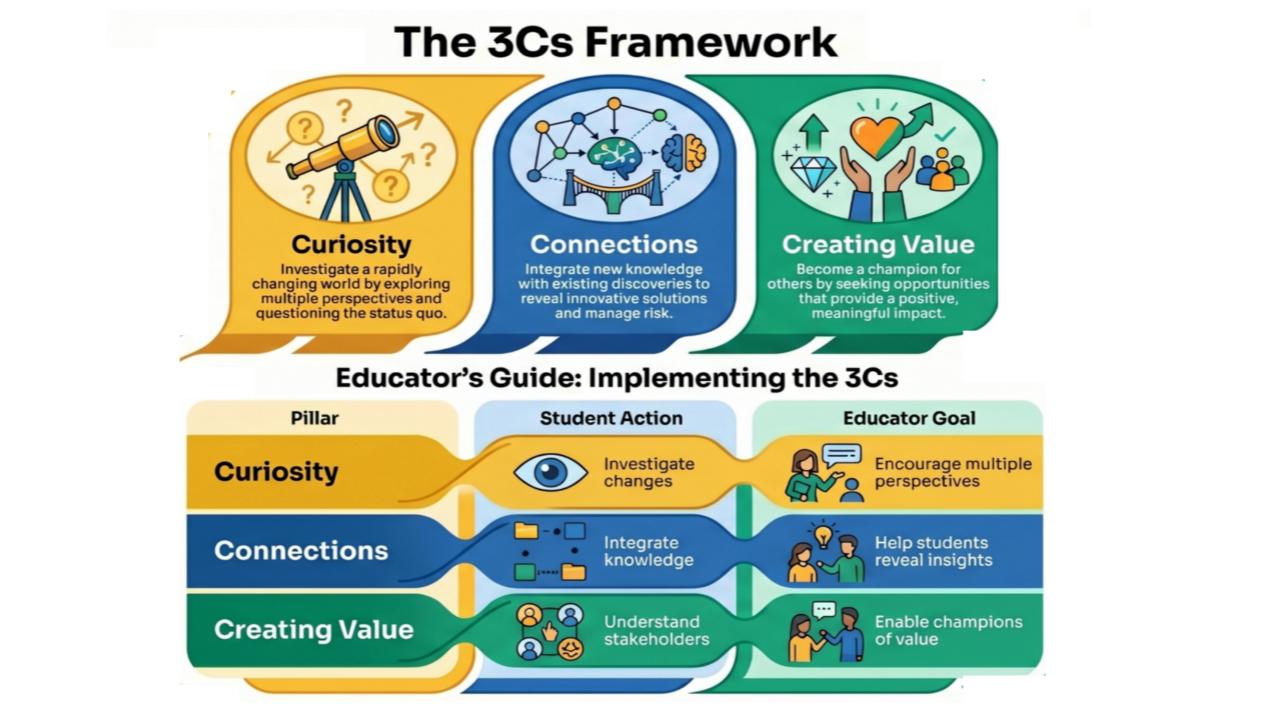
Engineers can no longer depend on just their technical skill set to be successful. They also need an entrepreneurial mindset. An entrepreneurial mindset (EM) encompasses attitudes, habits, and behaviors that shape a unique approach to problem-solving, innovation, and value creation.

The 3Cs of Entrepreneurial Mindset: Curiosity, Connections, and Creating Value.
A thorough understanding of the 3Cs helps engineering students question, adapt, and make positive change in classes, campus, communities, and the world.

The Kern Family Foundation has catalyzed EM through KEEN: Kern Entrepreneurial Engineering Network.

All content in this post has been distilled from the Engineering Unleashed website.

Source: Engineering Unleashed

OnAir Post: Entrepreneurial Mindset for Engineers
Entrepreneurship Mindset & CYSE

AI can out-produce code, but it can’t connect the dots: 

How do you become a great [cybersecurity engineer]? You spend years as a junior, mid-level, and senior developer. You learn by doing, failing, and executing.

What we’ll desperately need are engineers who connect business risk, human behavior, and complex systems to anticipate the attacks nobody has scripted yet.

I’m convinced the answer is Entrepreneurially Minded Learning (EML), the framework developed by KEEN (the Kern Entrepreneurial Engineering Network), built on a simple equation: Mindset + Skillset.

Curiosity (chase the context not given in the prompt). Connections (link technical decisions to other domains). Value Creation (security as business survival, not serverlocking).

Mindset alone doesn’t build judgment. Judgment used to come from a decade of breaking things as a junior.

EML has to do something harder than “teach curiosity”; it has to compress or replace the scar tissue that once came from years in the trenches.

Source: Engineering Unleashed

KEEN and College of Engineering and Computing

Why We’re In KEEN
We already embrace much of the KEEN Framework in our values and approach to engineering education. As a faculty, CEC has brought its own entrepreneurial mindset to our programs and initiatives. Discovery, inquiry, and synthesis are core values of the Mason student experience.

There are many examples of highly innovative programs we have created, such as:

  • We created the first-ever BS in Cyber Security Engineering, and ABET modeled its program criteria after our curriculum.
  • We pioneered a very creative dual-admission/transfer program for community college students, and approximately half of our 11,000 students follow that pathway to Mason.

onAir and CYSE

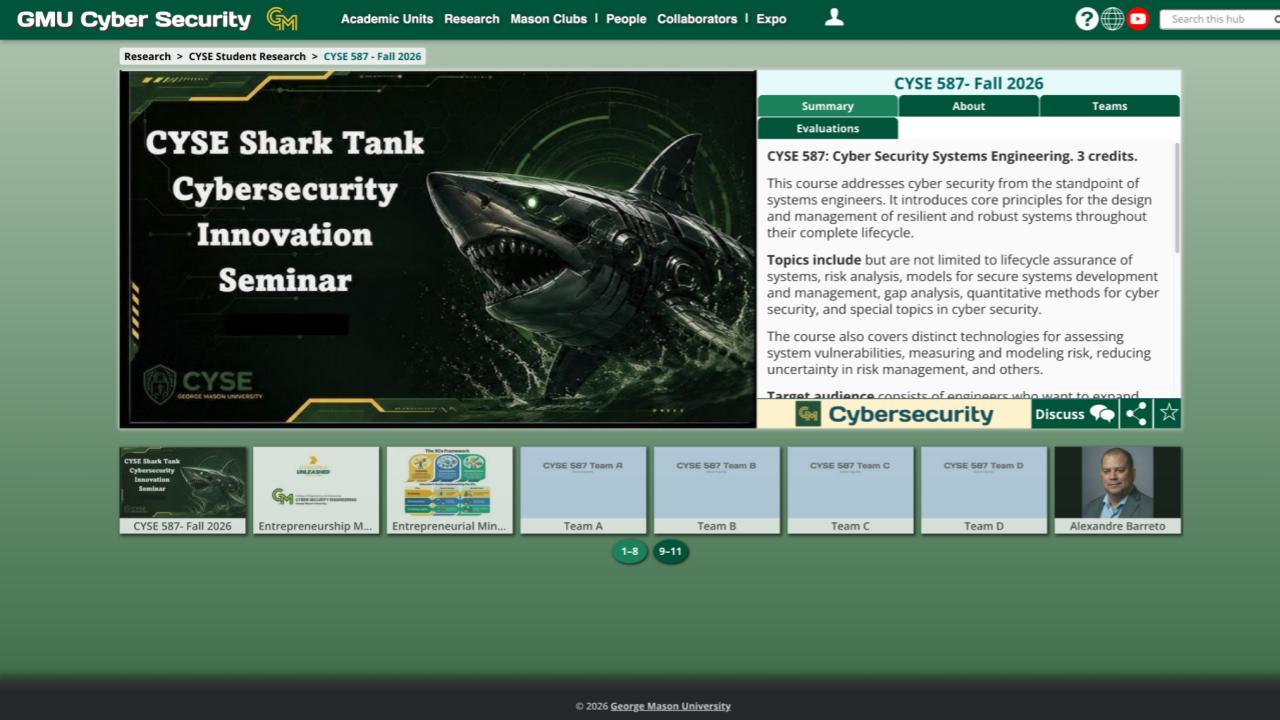
The goal is to use the GMU Cyber onAir hub and network of Cyber onAir hubs and especially the CYSE 587 Fall 2026 category as a dedicated repository where CYSE students can publish their ideas, refine their projects, receive feedback before Shark Events, and engage with the content.

Professor Barreto plans to use the onAir platform to share ideas on how EML can increase student engagement and better prepare them for the real-world problems they will face in the future and provides students with an innovative platform and gives onAir a concrete, active pilot to demonstrate its capabilities in a real-world academic setting.

Senior Design Capstone (2026-27)

The Senior Design Capstone, CYSE 492-493,provides students with a “real-life” industry project as part of their major design experience during their senior year. Student Teams work with sponsors, who are also the customers.

With advice from subject-matter experts, the teams complete meaningful engineering projects.

Guidelines

  • Each project is managed exactly as if the students were just hired by a company and placed on an engineering team. Students are responsible for generating the project plan and then executing the plan.
  • Throughout two semesters, they are guided in technical areas by the subject-matter experts and mentored by the instructor in a host of professional and business skills such as communication, teamwork, ethics, professionalism, company values, metrics, and new business acquisition.
  • By working in teams, they develop leadership and group interpersonal skills and deal with scheduling conflicts and meeting deliverables.
  • Students are responsible for managing customer relationships and solving the many real-life issues that undoubtedly occur.

Source: CYSE website

Cyber 587/687 – Fall 2026

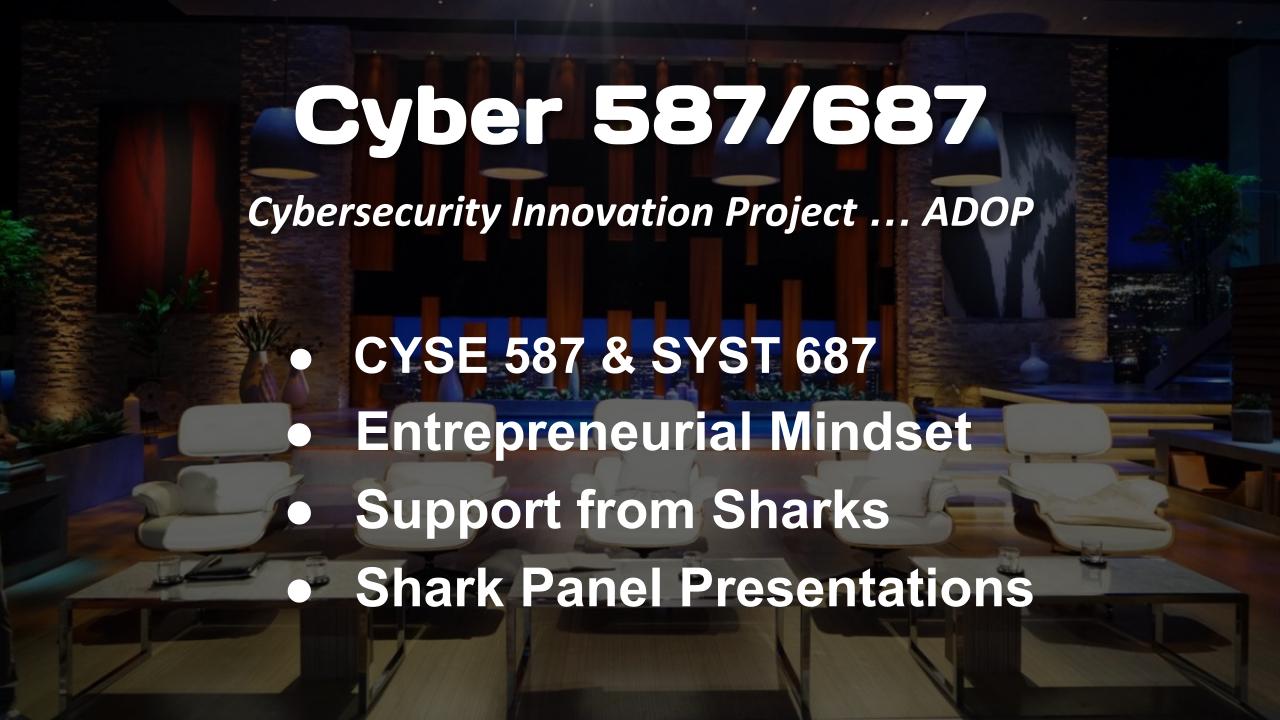
What is the CYSE-587/SYST-687 Project?

The final project for CYSE 587/SYST 687 is a collaborative capstone experience designed to transform academic theory into a tangible, high-value solution. This is more than a standard assignment; it is an entrepreneurial journey that requires teams to navigate the complexities of real-world problem-solving.

At the start of the course, students will self-organize into teams of five to address a problem domain defined by the instructor. Your mission is not merely to provide a technical fix, but to innovate. Operating as a startup team, you will engage in a continuous cycle of experimentation, development, and iterative refinement.

Alexandre Barreto

Alexandre Barreto is an Associate Professor, Department of Cyber Security Engineering at George Mason University.

He has applied his significant experience as an air traffic and air defense infrastructure manager to a career specializing in the field of cybersecurity and networking, which in conjunction with his research on cyber impact assessment, has led to applications in cyber and transportation security, and decision support systems in defense and critical infrastructure areas. These topics are at the core of his classroom activities at both graduate and undergraduate levels, as well as his research path.

Barreto is a researcher in impact assessment and secure air transportation protocols and developed innovative applications and extensions that aid in the fight against cyber-warfare. He received his MS and PhD from Instituto Tecnológico de Aeronáutica in Brazil.

Mingkui Wei

Mingkui Wei is an associate professor in the Department of Cyber Security Engineering. His current research interests focus on network security, especially on the application layer. He takes approaches including mathematical modeling and analysis, simulation and experiment, and machine learning, to identify and address security threats on the Internet.

His research results have been published in top-tier venues including IEEE INFOCOM, Usenix Security, and ACM CCS. He was a faculty in Computer Science at Sam Houston State University before joining Mason in 2021.

Degrees

  • PhD, Computing Engineering, North Carolina State University, 2016
  • MS, Information Systems, Southeast University (China), 2008

Paulo Costa

Paulo Costa has applied his significant experience as a fighter pilot to a career specializing in the field of electronic warfare and flight safety, which in conjunction with his research on probabilistic reasoning has led to applications in cyber and transportation security, heterogeneous data fusion, and decision support systems in healthcare, defense, and other areas. These topics are at the core of his classroom activities at both graduate and undergraduate levels, as well as his research path. Costa leads the research of graduate-level students in understanding security objectives and verification protocols, bringing in the science of probabilistic reasoning and challenging PhD-level candidates to consider theory and methods for building computationally efficient software agents that reason, act, and learn in environments characterized by noisy and chaotic traffic.

Costa is a key researcher in the field of probabilistic ontologies and has developed innovative applications and extensions that aid in the fight against cyber-warfare. In addition to his Mason assignments as Chair of the Cyber Security Engineering Department and Director of the C5I Center, Dr. Costa is Vice President for Securing Automation and Supply Chain Security (cymanii.org). He is a former President and current elected member of the Board of Directors of the International Society of Information Fusion (isif.org), as well as an IEEE Senior Member (SM13).

Degrees

  • PhD, Information Technology, George Mason University
  • MS, Systems Engineering, George Mason University
  • BS, Engineering, Brazilian Air Force Academy

Source: CEC Page

Mohamed Gebril

Mohamed Gebril is an associate professor in the Cyber Security Engineering department. He joined Mason after working as a primary patent examiner for the US Patent and Trademark Office (USPTO). In his seven years at USPTO, he was involved in patent examination and prosecution areas in the data storage and networking fields, where he worked in intellectual property matters directed to computer security, enterprise network security and authentication, databases, data processing, and memory storage devices.

Gebril completed his PhD in electrical engineering at North Carolina A&T State University in 2011 in the area of big data indexing, machine learning, and AI applications. He received his MS in electrical engineering from North Carolina A&T State University in May 2008 in the area of robotics navigation and optimization and completed his undergraduate studies in electrical engineering at Alexandria University, Egypt.

Source: CEC webpage

Duminda Wijesekera

Duminda Wijesekera is a professor in the Cyber Security Engineering Department at George Mason University. He was the inaugural chairman of the Cyber Security Engineering Department until December 2022, and a visiting research scientist at the National Institute of Standards and Technology (NIST) between 2007-2022. He leads the Mason Innovation Laboratory at Mason Square. He is also a fellow at the Potomac Institute of Policy Studies.

His current research addresses multiple areas. The first is the security and safety of cyber-physical systems. Research in this area includes the safety and security of Intelligent Transportation Systems (ITS) that include trains, aircraft, and connected/automated automobiles. Another area is digital forensics. Research in digital forensics includes creating potential scenario from evidence and creating frameworks for argumentations, error management of forensic data, and adding odds ratio between different scenarios that fit the evidence. A third area is applying formal methods to CPS safety and security.

Source: Webpage

Peggy Brouse

As director of the first-of-its-kind BS in cyber-security engineering program at Mason, Peggy Brouse is passionate about building a new breed of cyber-security professional. As the nature of cyber threats has grown, the demand for timely response and effective action has built the groundwork for a discipline of anticipatory action and security design. The future of cyber-resilience relies on products designed to resist cyber-attack. Engineers who graduate from Mason’s cyber-security will be prepared to work on teams that develop new technologies designed to safeguard vital systems and data. Brouse’s career in researching requirements engineering, decision support, and process improvement, along with her expertise in engineering education has uniquely equipped her to direct the course of this pioneer program.

Research Interests

Systems Requirements

Degrees

  • PhD, Information Technology, George Mason University
  • BS, Computer Science, American University
  • MBA, Marymount University
  • BA, Creative Writing, California State University, Long Beach

Source: Web page

Skip to toolbar