Entrepreneurial Mindset for Engineers

Entrepreneurial Mindset. The key to success for undergraduate engineering students.

Engineers can no longer depend on just their technical skill set to be successful. They also need an entrepreneurial mindset. An entrepreneurial mindset (EM) encompasses attitudes, habits, and behaviors that shape a unique approach to problem-solving, innovation, and value creation.

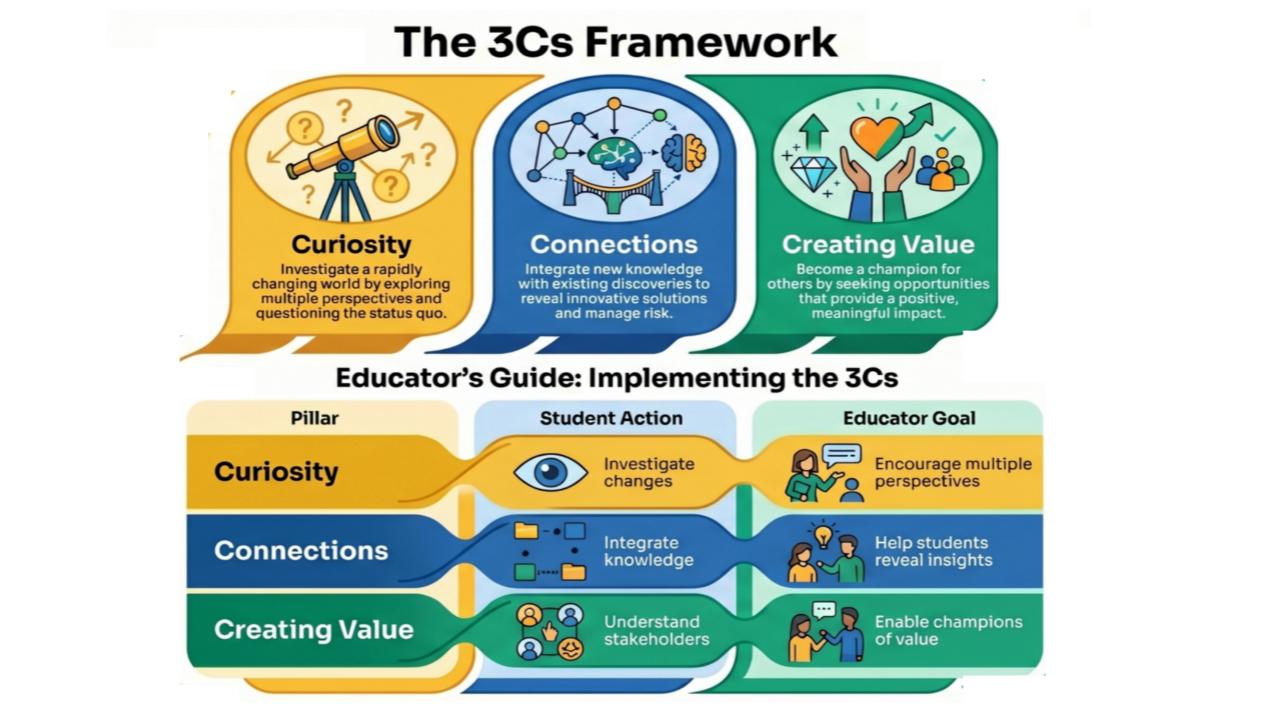
The 3Cs of Entrepreneurial Mindset: Curiosity, Connections, and Creating Value.
A thorough understanding of the 3Cs helps engineering students question, adapt, and make positive change in classes, campus, communities, and the world.

The Kern Family Foundation has catalyzed EM through KEEN: Kern Entrepreneurial Engineering Network.

All content in this post has been distilled from the Engineering Unleashed website.

Source: Engineering Unleashed

OnAir Post: Entrepreneurial Mindset for Engineers
Entrepreneurship Mindset & CYSE

AI can out-produce code, but it can’t connect the dots: 

How do you become a great [cybersecurity engineer]? You spend years as a junior, mid-level, and senior developer. You learn by doing, failing, and executing.

What we’ll desperately need are engineers who connect business risk, human behavior, and complex systems to anticipate the attacks nobody has scripted yet.

I’m convinced the answer is Entrepreneurially Minded Learning (EML), the framework developed by KEEN (the Kern Entrepreneurial Engineering Network), built on a simple equation: Mindset + Skillset.

Curiosity (chase the context not given in the prompt). Connections (link technical decisions to other domains). Value Creation (security as business survival, not serverlocking).

Mindset alone doesn’t build judgment. Judgment used to come from a decade of breaking things as a junior.

EML has to do something harder than “teach curiosity”; it has to compress or replace the scar tissue that once came from years in the trenches.

Source: Engineering Unleashed

KEEN and College of Engineering and Computing

Why We’re In KEEN
We already embrace much of the KEEN Framework in our values and approach to engineering education. As a faculty, CEC has brought its own entrepreneurial mindset to our programs and initiatives. Discovery, inquiry, and synthesis are core values of the Mason student experience.

There are many examples of highly innovative programs we have created, such as:

  • We created the first-ever BS in Cyber Security Engineering, and ABET modeled its program criteria after our curriculum.
  • We pioneered a very creative dual-admission/transfer program for community college students, and approximately half of our 11,000 students follow that pathway to Mason.
Skip to toolbar