Summary
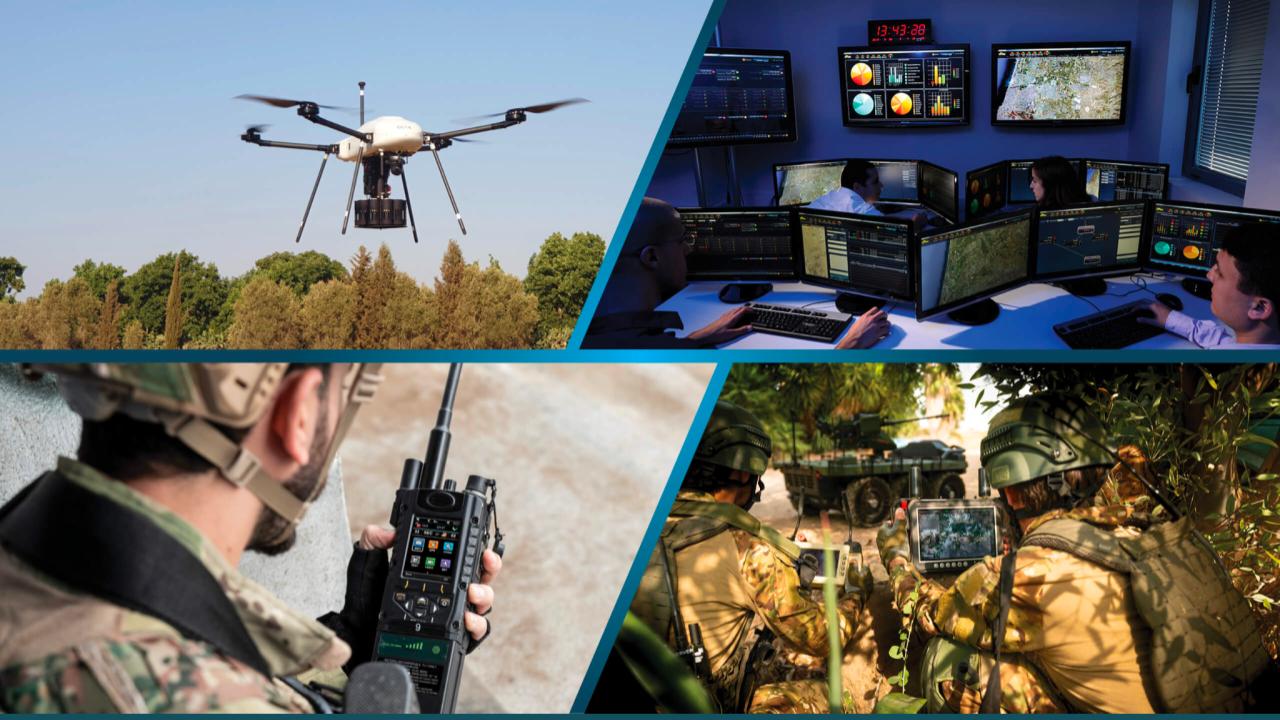
The C5I (Center of Excellence in Command, Control, Communications, Computing, Cyber and Intelligence) at George Mason University is the nation’s first and only civilian university-based entity offering a comprehensive academic and research program in military applications of information technology and cyber security.
Vision
To serve as a multi-disciplinary hub connecting faculty and researchers with interests in the Center’s mission and be widely recognized as a premier source of knowledge and innovation to military and civilian authorities.
Mission
The Center’s mission is to perform advanced research in defense, intelligence, and security-related applications in IT and Cyber; bridging cultural gaps and aligning requirements between government, industry, and academia.
News
After helping to develop the Systems Engineering and Cyber Security Engineering programs at George Mason, Professor Peggy Brouse has received the 2023 David J. King Award.
A member of the Mason nation for over three decades, Brouse joined the university as a PhD student in Information Technology (incidentally, the first program of its kind in the U.S.). After working as a systems engineer at MITRE for nine years, she started a research lab studying requirements engineering at Mason. She notes that while she enjoys research, has published widely, and has graduated many PhD students, her love as always been “in the teaching arena.”
“When I was teaching was when I really lit up,” she recalls. So, when Dean Andrew Sage approached Brouse roughly thirty years ago about starting a Systems Engineering department at Mason, she was happy to help develop the curriculum. She helped create the Systems Engineering bachelor’s degree program and went on to create the first bachelor’s degree program in Cyber Security Engineering in the country. She currently enjoys a split appointment between the Systems Engineering and Operations Research department and the Cyber Security Engineering department.
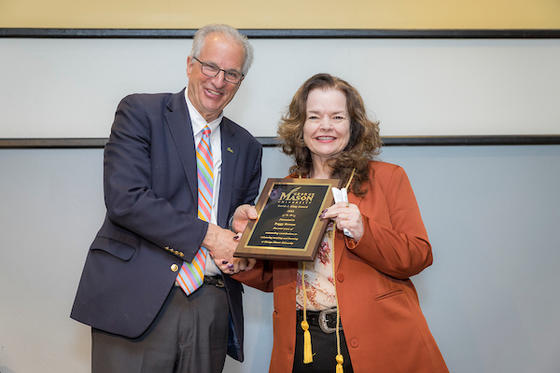
Brouse (on right) with Provost Mark Ginsburg accepting the David J. King Award.
Not only must nominees for the David J. King award be at Mason a minimum of 20 years, but they also must meet a host of other criteria. The award, created in 2001, carries on the legacy of former Vice President for Academic Affairs David J. King and recognizes the work of an excellent teacher whose research has brought honor to Mason and whose work has enhanced the student experience at an institutional level.
“It wasn’t a real dry speech; it was emotional for me,” Brouse says of her speech at the award ceremony. Several members of her family including her daughter Becky Brouse and sister, Robin West, were in attendance, along with what Brouse described as an eclectic group of colleagues from across the College of Engineering and Computing (CEC). In her speech, Brouse thanked her support system.
“You don’t get anywhere without other people being a big part of that, and a lot of that is my family,” says Brouse, adding, “I’ve been so blessed to have just amazing colleagues.” Colleagues she mentioned include the CEC’s Director of Undergraduate Academic Advising, DaFran Ware; Director of IT and Security, Jonathan Goldman; associate professor of electrical and computer engineering and Director of the Criminal Investigations and Network Analysis Center, Jim Jones; and professor of cyber security engineering and computer science Duminda Wijesekera. In addition, she acknowledged the impactful work of Paulo Costa, a longtime colleague and the chair of the Cyber Security Engineering department, and both Becca Stevenson and Lori Stevenson, the academic advisors for the department.
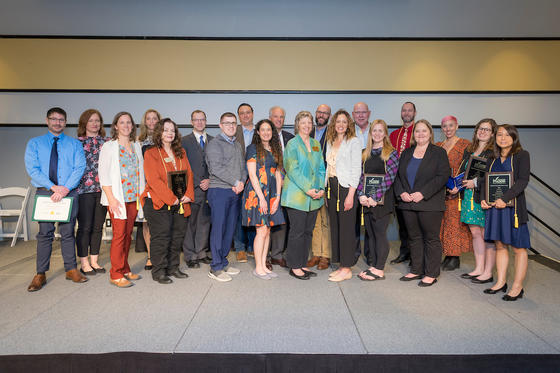
Brouse with other Teacher Excellence Award winners
During the ceremony, Vice Provost for Faculty Affairs and Development Kim Eby asked Brouse to share some advice with fellow educators. In addition to treating students fairly—for example, by grading assignments anonymously—Brouse suggested an exercise that has been especially fruitful with students in her senior seminars for both systems and cyber security engineering: an end-of-semester curriculum review.
“We ask them [students], ‘What did we do that we could do better?’,” she said. Brouse has worked to change both programs several times based on feedback from this exercise. She encourages fellow faculty to remain open to student feedback. “Whatever you’ve done, the fact is that these students are our future. They’re the ones that actually know a lot more than they’re given credit for.” She adds, “That doesn’t mean you have to take all their ideas, but they’ve come up with ideas we never would have thought of as faculty members.”
About
Goals
- Provide an intellectual base for the C5I area
- Integrate theories and results across disciplines for more understanding at the systems level
- Impact the synthesis and analysis of C5I systems
- Bridge cultural gaps among government, industry and academia in C5I
Strengths
Our center works in a broad spectrum of research interests, such as, sensing and fusion, C4 architectures, communications and signal processing, command support and intelligent systems, modeling and simulation, and information systems.
In addition, the Center’s leading edge work in probabilistic ontologies, information fusion, C2-Simulation interoperation, probabilistic forecasting, applied cybersecurity and cyber policy have established the Center as a significant research contributor in the Intelligence Community.
The Center provides a bridge between Mason faculty expertise and the needs of the Defense and Intelligence communities’ information technology users and research organizations. The Center conducts active outreach programs to government and industry, and is a leading contributor to NATO, AFCEA, STIDS and ICRRTS conferences.
Focus
The C5I Center is focused on achieving effective use of Command, Control, Communications, Computing, Cyber, and Intelligence systems and technologies by United States and allied military.
The Center strives to:
- Conduct a broad spectrum, multi-disciplinary research and development
program in C5I Cyber - Develop an intellectual base for C5I Cyber
- Support the Systems Engineering and Operations Research (SEOR) Department in providing a comprehensive C5I curriculum that leads to a certificate in C5I and also a Master of Science with specialization in C5I at George Mason University
- Act as a focus for doctoral research in C5I
- Provide technical support to industry and government in the C5I area
- Bridge the cultural cap between the Volgenau School of Engineering (VSE), other Mason faculty and the elements of the US Department of Defense (DoD) and its
supporting industries - Maintain a broad spectrum of research and education across:
- Sensing and Fusion – Area Leader: Dr. Paulo Costa
- Command Support / Information System Architectures – Area Leader: Dr. Ali Raz
- Modeling and Simulation – Area Leader: Dr. Michael Hieb
- Education, Training, and Workforce Development – Area Leader: Dr. Peggy Brouse
History
The Center of Excellence in Command, Control, Communications, Computing, Intelligence and Cyber (C5I Center) at George Mason University was established under the direction of Dr. Harry Van Trees in June 1989 in order to provide an intellectual base for the command, control, communications, and intelligence area (C3I). Dr. Van Trees’ remarkable experience spans active service in the US Army; graduate schooling and faculty service as a Professor of Electrical Engineering at MIT; service as Principal Deputy Assistant Secretary of Defense for C3I and Acting Assistant Secretary of Defense for C3I. Under his leadership, the C3I Center established a national reputation for academic leadership in military information technologies.
Upon Dr. Van Trees’ retirement, Dr. Mark Pullen became the Center’s Director in 2005. Dr. Pullen’s experience includes 21 years in the US Army, including positions of Associate Professor of Electrical Engineering at the US Military Academy (West Point) and seven years in multiple positions at the Defense Advanced Research projects Agency (DARPA). He added “Computing” to the center’s name (thus, C4I) and has continued its emphasis on bringing academic expertise to the needs of the U.S. military and related government and commercial applications of information technology. The Center conducts broad spectrum R&D and educational programs in C4I. The Center’s program is accomplished by bringing together a multi-disciplinary group consisting of academic faculty, research staff, and fellows in residence from industry and government. And it is also assisted by an advisory group. The Center moved into the beautiful, new Nguyen Engineering Building (pictured above) in the spring of 2009.
Command, Control, Communications, Computing and Intelligence (C4I) systems are essential to our national security. History provides many examples of how C4I has influenced the outcome of an engagement or an entire conflict. In spite of its importance there is not an adequate intellectual base for the C4I area, and comprehensive educational programs in C4I do not exist in civil institutions.
To fill these needs, the Center of Excellence in C4I at George Mason University is the nation’s first and only civilian university-based entity offering a comprehensive academic and research program in military applications of information technology. The center performs research in sensing and fusion, C3 architectures, communications and signal processing, command support and intelligent systems, modeling and simulation, and information systems. The center is allied with multiple academic departments, including Computer Science, Electrical/Computer/Telecommunications Engineering, Statistics, Systems Engineering and Operations Research. The last of these offers Master of Science in Systems Engineering with a major in C4I and also graduate certificates in both C4I and Military Operations Research. Research program personnel include faculty members from the Volgenau School of Information Technology and Engineering, research faculty members, government and industry research fellows, graduate research assistants, and thesis students.
While the center has been active in C4I systems issues associated with Cyber technologies for several years, the C4I name did not make this clear. Cyber is a major area of concern for our Department of Defense and Intelligence Community customers, so it became important that our Cyber expertise be evident in our name. At the beginning of 2016, the center name was changed to The Center of Excellence in Command, Control, Communications, Computing, Intelligence and Cyber (C4I & Cyber). In 2024, the center integrated the Cyber into the more abbreviated name, and is now simply the C5I Center.
Web Links
Videos
High-Level Data Fusion for Modern Command and Control (C2) and Counter Small Unmanned Systems
(04:25)
By: George Mason University Television
This project delivers innovative engineering and cost-effective technical implementation capabilities to address DoD’s critical High Level Data Fusion (HLDF) system architecture needs in the Counter Unmanned Aerial Systems (CUAS) mission area.
Our objective in this project is to create a flexible HLDF system architecture that provides system-of-systems interoperability between existing sensors and Command & Control (C2) systems, maximizes reusability of key technical resources including software modules, and supports future innovation and evolution of HLDF, C2 and sensing systems.
Projects
Project summaries below come from C5I website.
Cybersecurity Manufacturing Innovation Institute (CyManII)-
Department of Energy (DOE) will provide CyManII with $70M in 5 years to create economically viable, pervasive, and inconspicuous cybersecurity in American manufacturing to secure the digital supply chain and energy automation. The Institute is composed of 23 leading universities, 3 National Labs, and 50+ industry partners including CISCO, Schneider Electric, GE, and others. The projected budget is $120M for the 5 years. Mason is a Managing Partner (highest tier) and responsible for the East Cost Satellite Facility of the Institute.
DARPA SAFE-SIM Program – Applying Analytical Process with Multiple
The project is developing an integrated analytical process that ties multiple technical methods for analysis and evaluation of complex system and systems of systems. The team is investigating how to build a consistent logical notation for complex systems and tie to technical methods (e.g., graph theory, deep learning etc.) to help with closing feasible and infeasible paths and help answer analyst questions.
Full-Spectrum Intelligence, Surveillance, and Reconnaissance (ISR) Innovation and Integration (Air Force Central Command
Provide a UAV Sensor Testbed that has a rigorous analytical capability to predict Sensor Performance to improve Base protection from UAV threats.. C5I / SEOR is customizing the MUSCAT testbed infrastructure to provide a bespoke solution for established AFCENT requirements. The testbed will be capable of running detailed likely scenarios to evaluate and optimize sensor placement based on detection probabilities. In addition, future tasking will include incorporating Multi Sensor Fusion and platform analytics to assess swarm vs. single platforms as well as predict platform intent. SEOR is similarly customizing a Supply Chain Digital Twin and Dashboard for Resilient and Secure Defense-Critical Supply Chains.
NCMS Integrated Photonics For Sustained Military Operations (National Center for Manufacturing Sciences)
The project is investigating the efficacy and advancing the technology readiness level (TRL) of low size, weight, and power, and low cost (SWaP-C) free-space optics (FSO) battlefield communications using chip-scale integrated photonics technologies. This will include assessing potential in the context of performance requirements flowing from system engineering of potential use-cases associated with Army battlefield applications in communications and PNT.
ODNI/ARLIS: Recombinant AI: Exploiting Heterogeneous Data Fusion with Ontological Frameworks and NLP
This project is focused on developing analytical frameworks (e.g., ontological framework) to enable heterogenous data exploitation and fusion in support of Recombinant AI objectives. It builds on the outcomes of Natural Language Processing (NLP) applied to various documents in a given domain (e.g., data extraction, indexing, and translation etc.), an ontology framework, for example, will identify key entities of interest in that domain and how these entities are interlinked towards inferring root causes or potential future courses of action. It set foundations for exploiting and fusing heterogeneous data to overcome limitations of missing data and/or extract new information from disparate and siloed data sets.
Standardized High Level Data Fusion (HLDF) System Architecture for Counter Unmanned Aerial Systems (CUAS)
This project delivers innovative engineering and cost-effective technical implementation capabilities to address DoD’s critical High Level Data Fusion (HLDF) system architecture needs in the Counter Unmanned Aerial Systems (CUAS) mission area. Our objective in this project is to create a flexible HLDF system architecture that provides system-of-systems interoperability between existing sensors and Command & Control (C2) systems, maximizes reusability of key technical resources including software modules, and supports future innovation and evolution of HLDF, C2 and sensing systems
Anytime Reasoning and Analysis for Kill-Web Negotiation and Instantiation across Domains (ARAKNID)
The C5I Center supports Raytheon-BBN technologies providing state-of-the-art research on Applied ExplainableAI and Probabilistic Semantic Technologies. ARAKNID is part of the DARPA ACK Program (link) and is being developed to manage data on various threats in real-time to help decisions involving weapons, sensors and military assets. Important decisions are ultimately made by a real person, but automating machine-to-machine interactions is a significant tactical advantage when seconds and minutes matter.
Semantic Testbed for Inference Enterprise Multi-Modeling:
An inference enterprise model uses available information about an inference enterprise to predict performance of the enterprise.
Recent Publications
- Species-selective detection of volatile organic compounds by ionic liquid-based electrolyte using electrochemical methods
X. Huang, Y. Li, E. Witherspoon, R. He, G. Petruncio, M. Paige, M. Li, T. Liu, K. Amine, Z. Wang, Q. Li, P. Dong
ACS Sensor 2023 - Capacitive Deionization System with Ultra-high Salt Adsorption Performance: From Lab Design to Agricultural ApplicationsR. He, L. Kong, Y. Yu, X. Liu, P. Dong
Chem Comm 2023
Affiliated Centers
- System Architectures Laboratory
- Evolutionary Computation Laboratory
- Center for Secure Information Systems
- Center for Distributed and Intelligent Computation
- Learning Agents Center
- Sensor Fusion Laboratory
- Radio and Radar Engineering Laboratory
- 5G Innovation Laboratory
- Center for Resilient and Sustainable Communities

